

Push Button Locking Pin Vs Ball Lock Pin: What's The Difference?
Views: 0 Author: Site Editor Publish Time: 2026-07-14 Origin: Site


Sourcing quick-release fasteners frequently frustrates procurement teams and engineers alike. Interchangeable supplier terminology complicates the selection process, creating massive engineering headaches. Buyers often search for a simple pin but encounter dozens of conflicting names.
Both push button locking pins and standard detent pins use ball bearings for retention. You insert them through a hole, and protruding balls keep the pin in place. However, their internal mechanisms dictate entirely different safety, load-bearing, and operational outcomes. A misapplied pin can lead to catastrophic mechanical failure.
This guide breaks down the mechanical realities of push button pins (positive locking) versus standard ball lock/detent pins. You will understand their distinct internal geometries and load capabilities. Ultimately, this framework will help you specify the exact hardware for your application without over-speccing or risking mechanical failure.
Key Takeaways
Mechanism: Push button pins provide *positive locking* (balls cannot retract without button actuation); standard ball lock pins (detent pins) rely on *spring tension* for retention.
Safety/Vibration: Push button locking pins are mandatory for high-vibration and critical safety linkages.
Cost/Efficiency: Spring-loaded ball lock pins offer faster insertion/removal and lower unit costs for non-critical, high-volume applications.
Core Specification: Both types share similar shear strength capabilities, but differ drastically in axial/tensile pull-out resistance.
The Terminology Trap: Defining the Engineering Standards
Suppliers frequently lump various fasteners into a generic "quick release pins" category. This naming overlap creates dangerous sourcing confusion. An engineer might request a positive locking pin. Procurement might purchase a standard Ball Lock Pin because the catalog labels them interchangeably. Engineering standards, however, strictly separate these fasteners by their internal locking mechanisms.
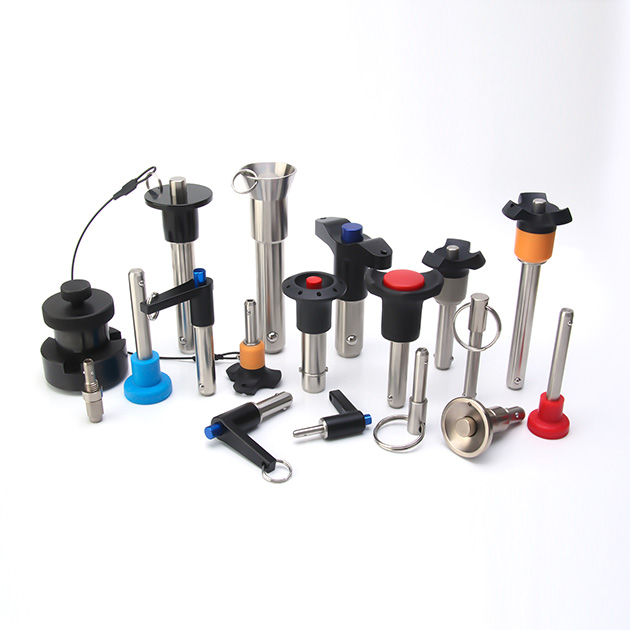
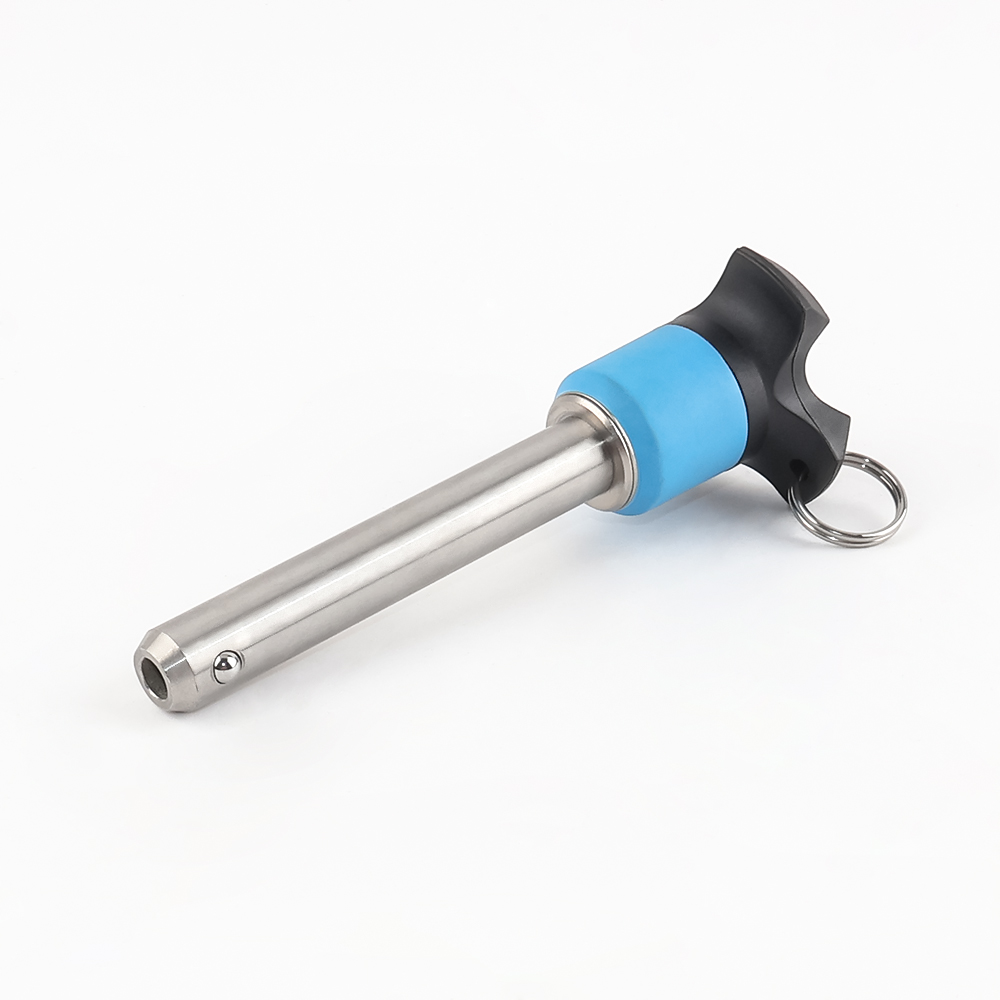
Push button locking pins feature a positive locking design. This definition relies on an internal spindle mechanism running through a hollow shank. The pin pushes its ball bearings outward through precise holes. These balls remain rigidly locked in the outward position. They cannot retract until an operator physically depresses the button to displace the internal spindle.
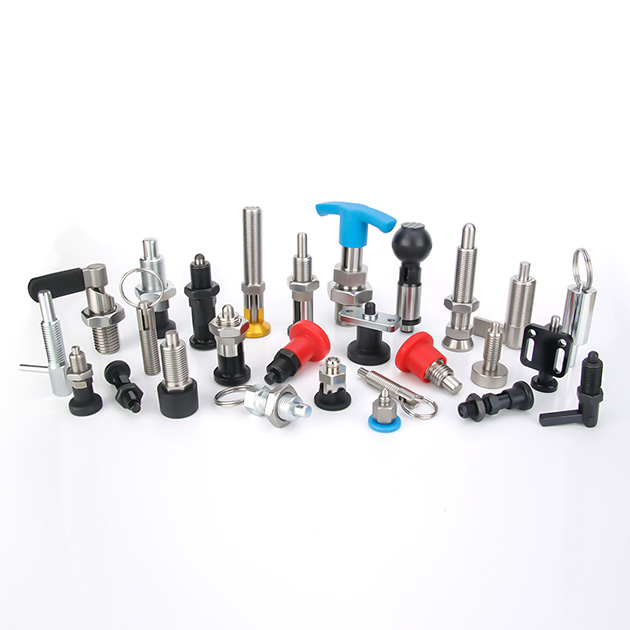
Standard detent pins operate on a completely different principle. They feature a solid shank with a drilled cross-hole. A simple spring backs the ball bearing mechanism. When you push the pin through a hole, the surrounding metal depresses the balls. Once they clear the hole, the balls snap back out. Outward spring pressure provides the only holding force.
Push Button Locking Pins: Performance Profile & Success Criteria
The operational mechanics of a push button pin hinge on its internal spindle design. In a single-acting configuration, a central spring pushes the spindle upward. The widest part of the spindle forces the ball bearings out. Pressing the top button pushes the spindle down. A narrow groove aligns with the balls, allowing them to drop inward. Double-acting designs expand this capability. You can release the balls by either pushing the button or pulling the handle.
This positive locking action delivers one primary advantage. It provides absolute security against accidental pull-out. The balls physically cannot retract without deliberate button actuation. Heavy vibration will not dislodge the pin. Snagged cables cannot rip it out of the assembly.
These mechanics dictate specific ideal use cases. You will find push button locking pins in heavy equipment rigging. Aerospace linkages mandate them under strict military standards. You should also deploy them in critical safety guards and heavy weight-bearing adjustments. In these environments, accidental release threatens human life.
However, you must account for specific limitations. The complex internal machining drives up the unit cost. Furthermore, the hollow shank introduces vulnerabilities. Heavy particulate matter, dust, or metal shavings can enter the mechanism. Without proper rubber sealing, the internal spindle can jam, rendering the pin inoperable.
Standard Ball Lock Pins: Performance Profile & Success Criteria
Standard detent pins eliminate internal complexity. Their operational mechanics rely simply on a solid metal shank. Manufacturers drill a cross-hole near the tip. They insert a robust spring and trap two steel balls on either side. Operators require a specific calculated push-force to insert the pin. They require an identical pull-force to remove it.
This simplicity creates a massive primary advantage. A standard Ball Lock Pin maximizes the speed of assembly and disassembly. Operators simply shove the pin in and yank it out. The solid design also leaves zero internal moving parts to jam. Dirt and debris rarely affect its function.
You should deploy standard detent pins in environments prioritizing speed over absolute security. Fitness equipment weight stacks use them extensively. Temporary manufacturing jigs and fixtures rely on them for rapid part swapping. Agricultural implements use them for fast field adjustments where operators wear heavy gloves.
Despite their speed, detent pins carry significant limitations. They cannot withstand any meaningful axial or tensile loads. If a dynamic load pushes against the balls, the spring will compress. The pin will simply pop out. They remain highly vulnerable to accidental removal if a worker snags the ring or lanyard.
Feature-to-Outcome Evaluation Matrix
Engineers must evaluate these fasteners across several technical dimensions. To clarify the selection process, review the core operational differences in the evaluation chart below.
Feature Profile | Push Button Locking Pin | Standard Detent Pin |
|---|---|---|
Mechanism | Internal spindle (Positive lock) | Internal spring (Friction lock) |
Tensile Load Capacity | High (Reliable pull-out rating) | Low (Releases under pressure) |
Vibration Resistance | Excellent | Poor (Risk of spring fatigue) |
Cycle Time | Moderate (Requires targeted actuation) | Fast (Simple push-pull motion) |
Shear Strength vs. Tensile Load
Engineers often misunderstand how these pins handle mechanical stress. We must clarify the facts regarding shear strength. Both pin types handle shear loads identically. The solid cross-section of the shank bears the brunt of sideways forces. Manufacturers typically machine both types from 17-4 stainless steel or hardened alloy steel. A half-inch push button pin and a half-inch detent pin offer nearly identical shear ratings.
The true differentiator lies in tensile load resistance. Tensile load refers to forces pulling the pin straight out of the hole. Only push button pins offer reliable pull-out load ratings. The rigid internal spindle blocks the balls from compressing. A standard Ball Lock Pin will easily fail under moderate tensile loads as the spring yields to the outward pressure.
Vibration and Dynamic Loading
Dynamic environments expose fasteners to severe sinusoidal and random vibration. You must assess the risk of spring fatigue. In a standard detent pin, heavy vibration causes the spring to rapidly compress and expand. Over time, the spring weakens. The pin can literally vibrate its way out of the hole. Push button pins solve this. The rigid spindle locking mechanism ignores vibration entirely.
Ergonomics and Cycle Time
Factory floors measure efficiency in seconds. Standard detent pins win easily on raw assembly speed. Operators grab the handle and shove it into place. Push button pins demand intentional, targeted actuation. The operator must consciously depress the button before pushing or pulling. This slows down the overall cycle time but ensures deliberate operation.
Cost at Scale
Manufacturing complexity drives pricing differences. A standard detent pin requires basic lathe work and a single cross-drilled hole. A push button pin requires gun-drilling a hollow shank. It requires machining a highly precise internal spindle. It requires assembling tiny internal springs and buttons. This explains the significant price premium associated with positive locking designs.
Implementation Risks and Deployment Realities
Specifying the right pin solves only half the problem. Poor implementation frequently causes premium hardware to fail. You must navigate specific deployment realities to ensure optimal mechanical performance.
Grip Length Miscalculations
Grip length dictates fastener success. We define grip length as the precise distance from the underside of the head to the leading edge of the locking ball. Failing to account for exact plate thickness creates immediate failures.
If you specify a grip length that is too short, the pin cannot fully penetrate the material. The balls will remain trapped inside the application hole. For a push button pin, this means the internal spindle cannot snap back into the locked position. The button will remain depressed. For a standard detent pin, a short grip length causes the balls to bind against the hole wall, destroying the spring over time.
Environmental Hazards
Industrial environments destroy unprotected hardware. The push-button mechanism remains vulnerable to environmental hazards. Dirt, ice, or metal shavings can infiltrate the tiny gap around the push button. Once debris enters the hollow shank, it packs around the internal spindle.
You can implement specific mitigation strategies. Specify sealed buttons with rubber O-rings for dusty environments. Use marine-grade lanyards to prevent drops into abrasive mud. If you cannot protect the pin from severe debris, a solid-shank detent pin might actually outperform a jammed positive locking pin.
Operator Error
Human behavior introduces unpredictable stresses. Operator error frequently destroys internal locking mechanisms. The most common danger involves users applying lateral force while depressing the button.
Operators grip the handle firmly.
They press the button to release the balls.
Instead of pulling straight out, they yank the pin at an angle.
This side-loading forces the internal spindle to scrape aggressively against the hollow shank walls.
Over time, this practice bends or severely wears the locking spindle.
To prevent this, train teams to align their pull strictly along the axial center of the pin.
Decision Framework: Which Pin Belongs on Your Shortlist?
Choosing the correct fastener requires a clear assessment of your application environment. Use the following framework to finalize your engineering shortlist.
Choose Push Button Locking Pins If:
The connection is life-safety critical. Any failure could result in injury or severe equipment damage.
The assembly experiences heavy, continuous vibration from motors or transit.
Your specific application involves upward or outward forces that pull against the pin.
Regulatory compliance mandates it. Mil-spec standards (like MS or NAS) frequently require positive locking hardware for flight and military use.
Choose Standard Ball Lock (Detent) Pins If:
The joint is subject strictly to shear forces. Zero axial pull will interact with the fastener.
Rapid, repeated adjustment is the primary user requirement. Operators need to change settings every few minutes.
The environment is highly abrasive but lacks dangerous vibration.
Strict budget constraints demand a cost-effective bulk fastener for non-critical assemblies.
Conclusion
The choice between a push button locking pin and a standard ball lock pin ultimately requires a calculated compromise. You must balance the risk of accidental release against assembly speed and unit cost. Push button designs deliver absolute security and vibration resistance through their positive locking internal spindles. Conversely, standard detent pins maximize cycle times and reduce costs through their simple, spring-loaded shanks.
Do not rely on guesswork when specifying critical hardware. Take action today to secure your assembly lines. Consult your engineering specifications to determine your exact shear load requirements. Measure your required grip length down to the thousandth of an inch. We highly recommend contacting your hardware sales team to request material data sheets and secure sample pins for real-world physical testing.
FAQ
Q: Can a standard ball lock pin be used in a lifting application?
A: No. Standard detent pins lack positive locking mechanisms. Snagged cables, shifting loads, or sudden impacts can easily overcome the internal spring pressure. The pin will pull out of the linkage. For lifting or overhead rigging, you must specify positive locking push button pins or heavily rated threaded fasteners to ensure safety.
Q: Are push button pins and ball lock pins interchangeable in existing holes?
A: Yes, provided the nominal diameter and the required grip length match exactly. Both pin styles require tight-tolerance hole preparation to function correctly. If the existing hole matches the specific decimal diameter of the pin, you can easily swap a detent pin for a positive locking design.
Q: What does "single-acting" vs. "double-acting" mean for ball lock pins?
A: These terms describe positive locking push button designs. A single-acting pin releases its ball bearings only when you push the top button. A double-acting pin releases the balls when you either push the button or physically pull up on the handle. Double-acting models are excellent for fast removal in tight spaces.
Q: Why is my push button locking pin sticking?
A: Sticking usually stems from poor maintenance or overload. A lack of dry lubrication increases friction on the internal spindle. Additionally, severe shear overload can slightly bend the shank, trapping the internal spindle. Finally, heavy debris or dust can accumulate inside the button housing, preventing smooth vertical movement.


