

What Makes A Ball Lock Pin Reliable?
Views: 0 Author: Site Editor Publish Time: 2026-07-11 Origin: Site


In harsh industrial scenarios, even minor fastener failure can trigger equipment damage, safety risks and unplanned downtime.
Ball Lock Pin should never be regarded as ordinary commodity parts, but professional engineered safety components that protect operators and high-value machinery. Their stable reliability stems from precise internal mechanics, application-matched materials and strict manufacturing tolerances, rather than accidental performance. This guide explains their internal working principles, material selection rules and common failure causes to help engineers avoid production halts and structural risks.
Key Takeaways
Stable internal structure: Precision spindle and spring systems maintain firm ball engagement under continuous vibration and mechanical loads.
Targeted material performance: 17-4 PH stainless steel provides excellent shear strength for heavy loads, while 300-series stainless steel delivers superior corrosion resistance for harsh environments.
Common failure causes: Premature malfunction rarely results from material fracture, but mostly dust ingress, spring fatigue and improper daily maintenance.
Supplier evaluation criteria: Prioritize manufacturers with strict dimensional tolerances, certified load capacities and complete quality testing procedures.
The Engineering Mechanics of a Positive Locking System
Standard detent pins rely on basic friction. Clevis pins rely on simple gravity. High vibration or heavy loads can easily dislodge them. Positive locking solves this baseline problem permanently. It requires deliberate mechanical actuation to release the retaining balls. Until you press the release button, the fastener stays firmly locked in place. Gravity and vibration cannot overcome the internal wedge.
Spindle and Spring Integrity
You press the button. It depresses an internal spindle. This downward movement allows the locking balls to retract inside the shank. When you release the button, the spring pushes the spindle back up. The spindle then forces the balls outward. Spring tension consistency drives everyday reliability. Operators rely on clear tactile feedback. If the spring feels weak, it creates immediate doubt about engagement. Strong, consistent spring tension ensures the spindle securely wedges the balls outward. This internal wedge action prevents the balls from collapsing under lateral pressure.
Ball Bearing Engagement and Tolerances
Precise ball seating is non-negotiable for safety. If the hole tolerance is too loose, your fastener experiences lateral play. This constant shifting leads to uneven wear. Eventually, the internal mechanism can jam completely. Reliable designs feature balls protruding at exact, uniform depths. This consistency ensures complete 360-degree retention.
Uniform engagement distributes the physical load equally. Uneven protrusion focuses intense stress on a single point. This imbalance risks premature mechanical failure. You must ensure the receiver hole matches the shank diameter tightly. Tight tolerances eliminate micro-movements during heavy machine operation.
Material Selection: Balancing Shear Strength and Environment
Unreasonable material matching leads to either excessive cost or rapid failure. Engineers need to balance shear strength, corrosion resistance and application scenarios to select the optimal shank material:
17-4 PH Stainless Steel: Features outstanding shear strength with standard corrosion resistance. Ideal for heavy-duty structural locking, widely used in aerospace tooling and high-load industrial equipment.
300-Series Stainless Steel: Lower shear strength than 17-4 PH, but excellent anti-corrosion performance. Suitable for marine equipment, medical devices and food processing facilities with humid and corrosive working conditions.
Alloy Steel: Cost-effective high-strength material for dry indoor industrial scenarios. Zinc-plated surface provides basic rust protection, meeting conventional high-strength locking demands with low moisture exposure.
Material Type | Relative Shear Strength | Corrosion Resistance | Ideal Use Case |
|---|---|---|---|
17-4 PH Stainless | Very High | Moderate | Aerospace, heavy machinery |
300-Series Stainless | Moderate | Very High | Marine, medical, food processing |
Alloy Steel (Zinc Plated) | High | Low | Indoor industrial, cost-sensitive projects |
Handle Materials and Ergonomics
You must evaluate handle choices based on operator use-case scenarios. Will operators wear thick protective gloves? Is the mechanical clearance exceptionally tight?
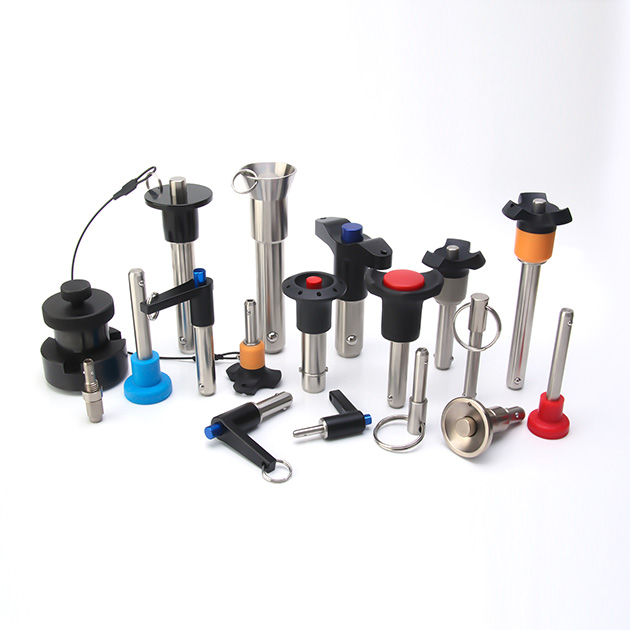
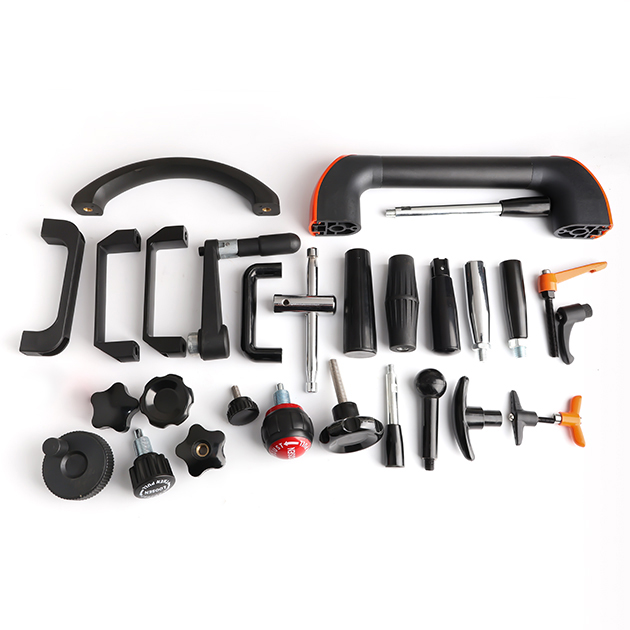
T-handles provide a firm, full-hand grip for heavy extraction. L-handles work perfectly in tight, restricted spaces. Button handles offer a sleek profile to prevent accidental snagging. Ring handles allow quick finger-pulls or easy lanyard attachments. Material selection matters just as much here. Cast aluminum handles are durable and incredibly lightweight. Thermoplastic handles are highly insulating and impact-resistant. They protect operators from extreme temperatures in high-heat environments.

Common Points of Failure (And How Quality Pins Prevent Them)
Even the absolute best designs fail in the field. When operators ignore implementation realities and environmental hazards, breakdowns happen quickly. You must anticipate these operational threats during the design phase.
Particle Ingress & Jamming: Dust, metal chips and grit easily enter button gaps, jamming the internal spindle and causing stuck buttons and failed unlocking. High-quality pins adopt tight-tolerance manufacturing to minimize gaps. Sealed structures and protective caps are equipped for high-debris environments to isolate abrasive particles and protect internal actuation components.
Accidental Impact & Snagging: Protruding buttons are prone to accidental collision by moving equipment, cables and cargo, leading to unintended unlocking. Premium designs adopt recessed buttons and low-profile ring structures to reduce exposed areas, effectively preventing snagging and accidental release in high-frequency operating zones.
Spring Fatigue Failure: Low-grade springs fatigue rapidly after repeated use, resulting in soft button feedback, incomplete ball extension and insufficient locking force. Reliable manufacturers apply aerospace-grade spring materials and strict cycle testing to maintain stable spring tension and consistent locking performance for long-term repeated use.
Lifecycle Maintenance for Long-Lasting Reliability
End-users often treat fastening hardware as "install and forget" items. This dangerous mentality leads directly to preventable operational halts. Regular maintenance directly extends component lifespan.
Routine Inspection Checklist: Verify smooth and full ball retraction when pressing the button; check instant rebound speed after release; inspect the shank for scoring, galling and bending; confirm handle firmness without cracks; and measure mounting holes for elongation. Oval holes cause uneven shear stress and cannot be fixed by replacing pins alone.
Scientific Cleaning & Lubrication: Avoid harsh solvents that damage internal seals. Clean surfaces with mild degreasers and apply PTFE dry lubricant to the button area. Wet grease easily adsorbs dust and forms abrasive sludge, while dry lubrication ensures smooth sliding without contamination.
How to Evaluate and Shortlist Ball Lock Pin Suppliers
Visually identical ball lock pins differ greatly in internal quality. Procurement must focus on verifiable technical indicators rather than appearance.
Certified Load Data: Qualified suppliers provide official double-shear strength and tensile strength test reports and comply with NASM/MS industrial specifications. Never adopt uncertified products for load-bearing structures to avoid safety risks.
Engineering Customization Capability: Excellent suppliers support customized grip lengths, lanyard configurations and special handles to solve on-site ergonomic and assembly problems, providing professional application technical support.
Sample Verification Process: Bulk purchase is not recommended initially. Obtain CAD drawings for digital fitting simulation first, then test physical samples in real production environments to verify tolerance matching and practical applicability.
Conclusion
Ball lock pin reliability depends on precise manufacturing tolerances, scenario-matched materials and standardized maintenance. Certified high-quality pins eliminate equipment failure and safety hazards caused by poor locking. Engineers shall refer to official technical datasheets and 3D models during design, and select customized specifications according to actual working conditions to ensure long-term stable and safe operation.
FAQ
Q: What is the difference between shear strength and tensile strength in a ball lock pin?
A: Shear strength resists transverse cutting forces, while tensile strength resists axial pulling forces. Ball lock pins are mainly designed for lateral shear load positioning, not for long-term extreme tensile load bearing.
Q: Can ball lock pins be used in rotational applications?
A: No. They apply only to static positioning and locking. Continuous rotation causes severe ball wear, heat generation and tolerance failure. Professional bearings or smooth shafts are required for rotating components.
Q: How do I determine the correct grip length for my application?
A: Grip length must match the total thickness of fastened materials. Excess length causes shaking and lateral stress; insufficient length leads to incomplete ball deployment and failed locking.
Q: Are standard ball lock pins waterproof?
A: Standard stainless steel pins resist surface corrosion but are not fully waterproof. Moisture may enter internal gaps. Sealed versions are required for wet environments, paired with regular dry lubrication to prevent internal rust and jamming.


